First Crusade
Foucault's PendulumThe First Crusade is presented as the beginning of a chain that leads from the establishment of a Christian kingdom in Jerusalem to the founding of the Knights of the Temple. Its importance in the novel lies both in that account of the order’s origins and in the way later characters recruit the Crusade into a fabricated history of secret societies and world-shaping plots.
Kingdom and Crusading Context
The recollection begins with Godefroy worshipping at the Holy Sepulcher and fulfilling his vow, followed by Baudouin becoming Jerusalem’s first king. The resulting Christian kingdom in the Holy Land, the narrator explains, did not make the wider conquest of Palestine secure: the Saracens remained a force, and life was difficult for the new occupiers and pilgrims. This contrast between Jerusalem’s symbolic and political achievement and the unsettled territory around it supplies the setting for the order’s emergence.
The Templars’ Foundation
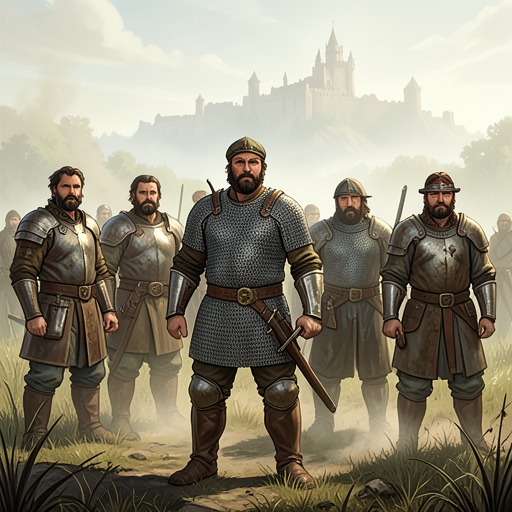
In 1118, during Baudouin II’s reign, Hugues de Payns and eight other young men arrived and established the nucleus of the Poor Fellow-Soldiers of Jesus Christ. The group combined monastic commitments with armed service. Its members took the familiar vows of poverty, chastity, and obedience, along with a fourth obligation: defending pilgrims. The king, the bishop, and others in Jerusalem supported them with money and lodging, and eventually housed them in the cloister of the old Temple of Solomon. From this association they became known as the Knights of the Temple.
The account distinguishes the founders from later recruits. Hugues and the original eight are described as probable idealists drawn into the Crusade’s religious fervor; later members are imagined as younger sons seeking adventure and prospects unavailable at home. Jerusalem is likened to a frontier where a person might make a fortune, and joining the Templars is compared to entering a foreign legion: the order offered food, clothing, travel, fighting, and the promise of salvation. That attraction came with a severe life of desert travel, tents, and long isolation, making the institution at once a spiritual vocation and a practical refuge for men with few good options.
Later Reinterpretations
Centuries afterward, the Crusading past becomes raw material for the novel’s modern conspiracy-making. Diotallevi places the major antisemitic campaign at the end of the nineteenth century and connects it, within the characters’ speculative account, to the publication of the Protocols of the Elders of Zion in Russia. Belbo then imagines the Jerusalemite group dividing into three branches: one associated with Spanish and Provençal Kabbalists and a neo-Templar current, another with a Baconian scientific and banking current, and a third in Russia. These supposed inheritances are presented as the characters’ explanatory fiction, not as established history.
The text exposes how such claims are assembled and repurposed. It describes the Protocols as twenty-four declarations that combine contradictory political prescriptions, from suppressing press freedom to encouraging social disruption, and attributes to the supposed conspirators a strategy of manipulating regimes, war, inequality, and public opinion. The account then traces a textual genealogy through Maurice Joly’s pamphlet against Napoleon III, which used ideas later echoed in the Protocols, and through a chain of adaptations that the characters extend backward to an earlier document attributed to Sue. This recursive construction turns resemblance into alleged proof of an unbroken plan.
Political Uses and Narrative Significance
The imagined history also shows antisemitic conspiracy as a political instrument rather than a reliable account of Jewish life. The novel recounts how Jesuit polemicists, after the Ordonation was attributed to them, redirected the accusation toward Jews; later writers cast Jews as satanic conspirators, while the Protocols’ circulation gave fabricated claims an appearance of documentary authority. In the characters’ version of events, Rachkovsky alters material associated with Elie de Cyon by substituting Jews for Witte, and the resulting text is passed through intermediaries to the tsar. The conspiracy thus appears to explain political conflict while helping to produce it.
The First Crusade’s historical role and its later conspiratorial afterlife remain sharply distinct. The order’s establishment is narrated through vows, institutional support, and the defense of pilgrims; the supposed survival of its hidden agenda is an invention built by connecting texts and groups across centuries. At its most extreme, that invented logic claims that the Nazi genocide of Jews was a search for a concealed clue that would locate the earth’s telluric center. The episode reveals the moral danger of the Plan: it converts mass persecution into evidence for an all-encompassing secret, making real victims serve a fiction that claims to explain everything.